Order Before 3PM EST
Get Same Day Shipping
Get Same Day Shipping

By early 1981, Hans Joachim Stuck was at a transitional point in his career. Having left behind a career in Formula 1 and single-seaters, his sights were set on building on his already well-established success in sportscars, touring cars and endurance racing. A major part of that would be attempting to win the 24 Hours of LeMans, where to this point he had not yet had an opportunity to win the race overall in a top-class prototype. With a major change in sportscar regulations coming that would see a great deal of enthusiasm from teams, drivers and fans alike, that was about to change.

In 1982, the Group C Sportscar category was introduced by the FIA, and it wasn’t long before it was accurately referred to as “Formula 1 with roofs”. Cars would now be regulated to a minimum weight of 800 kg (just over 1750 lbs, about the same weight as a current-day Formula 1 car) and allowed a maximum fuel usage of 600 liters for every 1000 km travelled. Other than that, the formula left a lot of room for manufacturers to experiment, encouraging different power unit applications and aerodynamic concepts. This was very appealing to brands who could now participate in a well-supported, world-class series with relatively minimal restriction. Participation would soon reach an all-time high from teams and car-makers from all over the world and, as usual, one of the earliest adopters of this new set of regulations was Porsche.


At the time, Porsche’s factory and test track were located within 100km of Hans Stuck’s primary residence in Germany; meanwhile, many of their established factory drivers were much farther away, living elsewhere across the globe. This led to Hans being contacted by Porsche initially out of convenience. In 1984, he was recruited to help test and develop the 956 and 962 prototypes, as well as provide professional driving experience for some of Porsche’s customer teams. By 1985, though, he would become one of the most important drivers in the brand’s history.

Stuck made his return to America for the major IMSA/endurance rounds with Bob Akin Motor Racing, who iconically ran Coca Cola liveried Porsche’s starting with the Group 5/GTP 935 and soon transitioning to the GTP/Group C 962 in early 1985. Meanwhile, in Europe, Hans was partnered with Derek Bell to drive the fully factory backed Rothman’s/Porsche 962 in the World Sportscar Championship, which included the 24 Hours of Le Mans.

In his first appearance for Porsche at LeMans in 1985, Stuck drove the 962 to pole position during qualifying and, in doing so, broke the track record, becoming the first ever driver to average over 250kph around Circuit de la Sarthe. That year, he and Bell finished the race 3rd overall, having been beaten by two sister car 956s.

In the 1986 race, a mixed weather qualifying session led to a somewhat unpredictable starting grid, though still littered with Porsche factory and customer entries. This time the 962s ultimately prevailed, and Stuck, Bell and American teammate Al Holbert drove their car to victory lane, finishing 8 laps clear of their closest competitor. The same factory squad went on to win the 1987 race as well, and Stuck quickly became as big a legend for Porsche as he had with BMW. 
Hans recalls, “Before, I was maybe the funny guy, never taking care about anything. But with this move to Porsche, I learned to be respectful, and it took me to another level professionally, and driving the 962 as a factory driver was the utmost moment in my career. Porsche put together a car that was perfection for a driver.”

At the peak of his career with Porsche, Hans was also given the opportunity to race with one of their subsidiary companies, Audi. The brand was set to make its first factory return to motor racing since his father (Hans Stuck Sr.) had raced for them with Auto Union in the pre-war era. Their plan, similar to what Porsche and BMW had done in previous years, was to present some of their newest platforms to both the United States and European markets via IMSA and, in this case, the DTM/German Touring Car Championships, both of which were at the peak of their popularity. This exposure would then, in turn, raise their company profile and expose the brand to new potential road car customers.

In America, Stuck piloted the legendary Audi 90/Quattro to seven IMSA GTO class wins in the 1989 season before the car was banned due to its sophisticated Quattro/All-Wheel Drive system rendering it impossible to beat in its class. From that point on, Audi’s presence would grow exponentially in America to the point where they are now considered one of the most popular European car brands in the country.
Back home, in Germany, Audi entered the DTM in 1990 with their luxurious and unassuming V8 Quattro. Here, they were set to compete against the likes of BMW and Mercedes, who at the time were both in their respective primes with the Group A E30 M3 and Mercedes 190E platforms. Stuck piloted the V8 Quattro to the DTM title that season despite having to work around historically stringent success ballast rulings. As a matter of fact, a running paddock joke from that time was that the Audi team was forced to weigh their car down with anything and everything, including pots full of German sausages just to keep the rulemakers satisfied - an almost ridiculous concept given how big and heavy the car already was by design.

Stuck’s success with Audi was yet another seminal moment in his career because not only did it add to his legend; it carried on a personal family tradition, having won with the same marque that his father had such great success with decades earlier.
By the late 1990’s, Stuck grew to take on more of an ambassador role rather than a full-time racing driver, though he continued to compete at major events into the mid 2000’s’. Some of these appearances included an overall win at the 1998 Nurburgring 24 Hours with the diesel-powered BMW/E36 320d; the first major racing win for a diesel-powered vehicle in history. He also made regular appearances with BMW in IMSA throughout the early 2000’s, driving the legendary PTG E36 and E46 GT’s. This included a class victory at the 2001 Petite LeMans alongside teammates Boris Said and Bill Auberlen.

Stuck announced his retirement from driving in 2011, at that year’s running of the Nurburgring 24 Hours, and he did so at the same track where he began his illustrious career 42 years prior. Since then, he continues to make regular appearances at motor racing events and automotive happenings all over the world. Stuck has always lived a front-facing life in terms of his media availability, where he will rarely shy away from an interview or documentary appearance, all of which are well worth checking out.
From the driver’s seat, Hans-Joachim Stuck helped build, and, in some cases, rebuild, some of the most iconic brands and racing teams in motorsport history. His career spans more than four decades, from motorsport’s golden age well into the new millennium, encompassing an era of technological evolution so profound that it is difficult to imagine ever seeing anything like it again.
Yet beyond the races, championships, and legendary machinery, Stuck’s legacy is defined equally by his character. His talent, personality, humor, and fearlessness made him one of motorsport’s most distinctive figures, a true legend whose career helped define an era of racing.
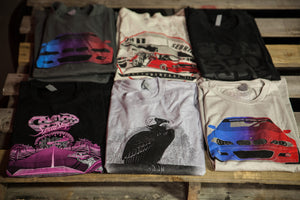
Thank you for taking the time to read our BMW Racing Legends Series piece on Hans Joachim Stuck. As always, please stay tuned to our resources section for more historical content such as this, and please visit condorspeedshop.com for historical BMW racing-inspired merchandise and memorabilia, where we now have limited-edition pins available for purchase, the first of which commemorates the iconic 1982 Spa 24 Hour Winning/Bastos Racing BMW 528i.
Leave a comment