
Order Before 3PM EST
Get Same Day Shipping
Get Same Day Shipping

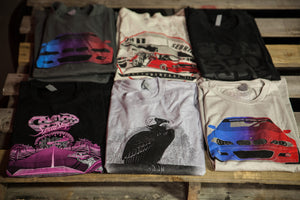
As a follow-up to our recent merch release and Group A E30 M3 write-up, we recently had the pleasure of interviewing Phillipp Kennewell, who is the current owner of the Team Kalaschek Group A/DTM E30 M3. Philipp is a great, down-to-earth guy who simply loves racing and has an awesome approach, similar to the vehicle’s original owner, Hans Kalischek. His recollections of the car’s history and restoration process offer amazing insight into what it’s like to achieve the lifelong dream of owning such an iconic piece of automotive history. So without further ado, please enjoy our interview with Philipp Kennewell.
Were you a fan of the 80s-era DTM in your younger years?
Yes, as long as I can remember, Motorsport in the “good old days” was always of my interest, and I was a big fan of the old DTM
When and how did you acquire the Kalaschek car?
The car got my attention pretty early. When speaking to my friends, I always said, “ I do not want (just) any M3, I want that one”. But in those days, owning a DTM M3 was far, far away from what I believed would happen. Then I got to know the owner of the car at a historic Race at Salzburgring and we became friends. I said to him, “If you ever want to sell the car, please call me first”, but I never believed this would happen. Then, after 3 years, I got a call from my friend who said he wanted to sell it. I didn’t hesitate, and the next day I visited him and we took a closer look at the car and all the spares he had, and finally I bought the car. This was in 2019.


What condition was the car in when you acquired it?
The car was “race-ready,” but we gave it a big service. We rebuilt the engine and transmission, the brakes, and so on. We also put it back to the original Group A spec and removed the Carbon fibre Hood, fenders, and doors, and put steel ones back on to have it period correct.
How much work was involved in restoring it as it is today? Is the car still in its original Kalaschek livery, or was it restored/recreated later?
Up to now, the car has taken about 1500 hours to bring it back to period correctness and to service everything, and to sort out some minor problems like rust or old accidents that have been repaired quick and dirty. The car has its original Kalaschek livery back on. It had been stripped down to just a blue car in the late 90s, but we recreated the livery and put the stickers back on.
What are the engine specs, and what does the car weigh in race-ready form?
The Engine is a 2.5 L S14, 1990 spec, Double injection, with a slide throttle. It has about 360 HP @ 9400rpm. The car is pretty light for an M3 chassis because it was an early motorsport chassis. Race-ready, we weigh in at about 960 kilos.

Were parts hard to come by? How much of the car is original (chassis, engine, suspension) versus restored or updated?
Yes, special parts for the M3 are really hard to find. You have to know where to search, and if you find something, you have to be really quick. We have collected quite a big stock of original parts over time, but we also reproduce a lot of parts for the M3 racing community to keep the cars on the racetrack.
The chassis is original, as well as the interior parts. Brakes are original, and gearbox and suspension as well. As you can imagine, the engine has been swapped several times in a racing season, because in 1990 and 1991 the most powerful engines lasted about 4 hours before they needed a service or stuck a rod through the block.
Were there any unique modifications or quirks specific to Kalaschek’s team?
The Kalaschek Team built their car on their own, so a lot of things are similar to the chassis from BMW Motorsport, but not the same. The rollcage is completely different, the engine is further back, and so on, but that’s a good thing now, so no one can build a real replica of the car without the original.
Do you know the full race history of this chassis (which races, which years, which drivers)?
Yes, I managed to get all the log books of the car, and so I know every event and every driver.
What’s it like to drive compared to other Group A / DTM E30 M3s?
I haven't driven any other M3 yet, but compared to a 635 Group A or an E9 3.0 CSL, it drives like a Gokart. You really have to work hard, but you get instant feedback from the car and it almost drives like on rails… I love it!
Does the car have any particular handling traits that stand out (good or bad)?
You get a big amount of feedback, and as my car is set up pretty soft, it is pretty “forgiving” if you go around a corner too quickly or if you drift, it's really good, controllable. And the brakes are really good.

How does it feel being behind the wheel of a car that was once a privateer’s underdog entry?
I simply couldn’t be happier. Not because it’s the quickest car around the track, but because it is my dream come true, and I now own an original car that has, in my opinion, the nicest livery out on the track. It is a unique car that no one has a similar one, and it simply is something special. But also, you have to keep in mind to be careful not to crash it because it is not a replica.
Do you plan to keep it as a pure historic race car, or compete with it regularly?
We will keep it in the 1989/1990 spec and compete regularly in historic race events.
How do other BMW or DTM fans react when they see it on track?
We get a lot of positive feedback at the racetrack because of the wild livery. Since the Kalaschek Team was from Munich, we have a lot of people here who can identify with it, so they really like it. Once we had a race as a support series for the DTM in 2023. One Guy came to us and said, “It's nice to see that the DTM is driving here as our support program” =)

What does keeping the Kalaschek story alive mean to you personally?
As I know Hans Kalaschek's son and the addiction to Motorsport of the Kalaschek family, it is a pleasure to keep the car present in Racing condition.
Do you know anything about Hans Kalaschek’s approach to racing or his team?
The early 1990s: The Wall had fallen, both German states were on the verge of reunification, the Cold War was almost over, Germany won the Soccer World Cup in Italy, techno music was on the rise, and fashion was becoming increasingly flashy. Neon-colored sweatpants and T-shirts were totally trendy back then—looking back today, rather 'quirky.' But it was exactly this flashy lifestyle that the BMW M3 E30 used in DTM in 1989 by Hans Kalaschek from Oberhaching conveyed. The body in intense light blue, bright red rims and side mirrors, neon yellow stripes converging toward the front, and a bright red star on top—the BMW M3 E30 of Hans Kalaschek could have also been a BMW Art Car, so much did his race car differ from the rest of the M3 crowd, which usually came in white. The 'artwork' was created more out of necessity, as no sponsor could be found for the DTM races. After only one season, however, the M3 disappeared from this design in the DTM again. The name Hans Kalaschek appears in the result lists of the 1970s and 1980s intermittently. His name can be found in Formula Vee and Super Vee, at the Formula 3 airfield races in Erding, in hill climbs, in the Austrian Touring Car Championship, and also in the European Touring Car Championship. At the same time, he also regularly maintained race cars in various racing series.
Starting in 1987, he built up the blue BMW M3 E30 in his workshop in Oberhaching, which he used in selected races from 1988 until the end of 1990. His best result was 15th place at the final at the Hockenheimring in 1990. During these DTM years, a close collaboration also developed with Harry Valier from Erding, another suburb of Munich. Valier supervised the entries of Team Vogelsang for many years and later built his own team, in which drivers such as Harald Grohs, Franz Engstler, Kurt König, and Luca Magiorelli competed in BMW M3 cars. From 1991, Harry Valier and Hans Kalaschek, as a factory-supported team, gained even more insight into racing politics and had to realize how BMW’s customer racing department treated privateers. Hans Kalaschek felt particularly connected to the BMW M3 and often said, ‘You can put the M3 in boxes for me, take out a screw, and I will tell you where it goes. That’s simply my car.’ In 2009, fate was particularly harsh. At the age of 60, he died of a heart attack during a race at the Salzburgring while driving a BMW M3 E30 DTM.

What do you think this car represents in the larger BMW Motorsport story?
I think this is one of the last cars from the small private teams; all other cars disappeared in other racing series and were destroyed over the years.
Once again, we would like to thank Phillipp for sharing his story with us, and if you ever have a chance to witness him or any historic racing series in action, we definitely recommend it. The spirit of racing is alive in many of those series and can be easily identified with by multiple generations of fans and enthusiasts. Best of luck to Phillipp in his winter prep for his 2026 season of events, and please stay tuned to our resources section for more historic racing content.
Leave a comment