
Order Before 3PM EST
Get Same Day Shipping
Get Same Day Shipping

Prologue
In the world of motorsport, few categories have consistently managed to blend raw competition, manufacturer pride and pure passion from its fans quite like touring car racing. Unlike most open wheel and sportscar series, touring car racing has consistently showcased common cars that people could identify with throughout its history.
 At its peak in popularity, it’s hard to overstate just how important touring car racing was to motorsport enthusiasts. In the 1980’s and 90’s, series like the DTM, BTCC, ITCC and ETCC held a place in racing fans’ hearts rivaling even Formula 1. Manufacturers such as Mercedes, Volvo, Alfa Romeo, Audi and Ford all fielded factory teams in that time period, battling for supremacy against perhaps the most iconic touring car brand of all time, BMW.
The genesis of this iconic era in touring car racing came on the heels of the Group B and Group 5 categories coming to an end. Due to safety issues, homologation cheats and lack of road car relevance, it became necessary to draw clearer distinctions in the sporting regulations; in order to separate production based touring cars and rally cars from purpose- built sportscar prototypes. Both categories had seen “production-based” cars pushed beyond the extreme and while it made for incredible racing and technological advancements, the consequences left motorsport governing bodies and manufacturers in precarious and unsustainable positions.

 The solution to this would be called “Group A” and in 1982, this new set of rules invoked a more strict homologation process, calling for exponentially more road going units to be built both initially and throughout subsequent years of racing competition. This would help ensure safety and longevity for all participating drivers and manufacturers. Though Group A was initially scrutinized by motorsport fans, this practical set of rules is responsible for some of today’s most legendary production cars, which dominated both racing circuits and rally stages. Perhaps the most legendary of all of them is the BMW E30 M3.
 Natural Evolution
BMW first entered Group A Touring Car racing with their stylish E24 M635 CSI, which was basically one in the same with their top of the line M6 model. These were the early days of BMW Motorsport, often referred to as “M”, where its only predecessor at this point was the iconic and storied BMW M1. In fact, it was the M1’s S38 power unit that powered the 6-series racing cars to Touring Car victories across Europe and Australia.
Though the E24 was a very successful platform for competition, BMW saw an opportunity within the sport to market one of their newest models. This was a remarkable time in motorsport where once again the cars on track mirrored those in the car park, and what better way to sell more units than to showcase them through racing.
 In 1984, BMW launched the E30, the successor to the first-generation E21 3-Series. It fell in line with their more traditional concepts of a lightweight, small saloon car that could be driven to the office during the week and handle a weekend drive through the mountains with ease; a perfect formula for a Group A competitor. Where as the previous generation’s E21 3-series was a true successor to the 2002, the E30 bridged the gap to a newer generation of comfort, luxury, and technology while maintaining the essence of BMW’s pure driving experience.
 Initially, customer race cars were built from the 325i chassis and were powered by the mighty, straight-six M20 engine. Although these cars were great in their own right, they were not specifically built for racing. For further development of that concept, BMW turned to its “Motorsport” division, where it would go on to develop the legendary E30 M3.

A Legend is Born
BMW began production of the M3 in March of 1986, and as intended, these cars were built to maximize performance under the Group A rule set. The chassis was nearly identical to the previous non-M variants, but the body was bespoke, maximizing its box flares in all the right places as much as the rulebook would allow. The power unit was also uniquely different, where previous road car engines featured reliable single-cam, belt-driven 4 & 6 cylinder layouts, the S14 showcased a compact, dual-overhead cam 4 cylinder configuration, designed to make all of its power on the higher end of the rev range. BMW was setting a new standard for touring car competition in almost every way with its new M3, and the results would soon speak for themselves.


The E30 M3 was ready for competition by the start of the 1987 season, and there would be no teething problems. In its first year of competition, the M3 won the World Touring Car Championship, European Touring Car Championship, German Touring Car Championship (DTM), Italian Touring Car Championship, Australian Touring Car Championship, the AMSCAR series, and the Japanese Touring Car Championship. In the same year, the M3 also won both the Nurburgring and Spa 24-hour races, along with the Tour De Corse Rally in the hands of the Prodrive racing team, in which it beat the four-wheel drive Lancia Delta Integrale by over 2 minutes. French Rally Driver Bernard Beguin would later recall, “People always look at Subaru as the beginning for the company (Prodrive) in the WRC, and, of course, Subaru was a huge part of the success. But the foundations for what we did with Subaru were all laid with BMW”. Championship-winning BMW factory Driver Roberto Ravaglia also remembers the M3 very fondly, saying, “When I first sat inside an M3 race car, I thought: this is absolutely made for me. Let the competition try and get past us”.
 The subsequent years brought much more success on and off the track. By the end of 1992, the E30 M3 would amass over 30 Touring Car Championship titles and 9 major endurance racing victories in its 6 years competing, and even though the car was somewhat limited in its rallying capabilities due to its two-wheel drive layout, E30 M3s are still known to be some of the most competitive Group A rally cars on tarmac.
Road test reviews from publications and television programs continued to praise the M3. Many manufacturers followed in this era with stellar examples of their own “homologation specials”, the M3 was first to the party in many ways. The competition inspired Mercedes 190Es, Alfa 155s, Subaru Imprezas, Audi V8 Quattros, and Ford Sierra Cosworths are just a few of the iconic cars that came afterwards; all of which owe a tip of the hat to BMW.
 There is something to be said about the soul behind these cars as well. They simply look and feel special. Automotive journalist and racing driver Tiff Needell would rightfully call it “a wolf in wolf’s clothing”. There just aren’t a lot of other saloon cars out there quite like it. All told, BMW would build close to 18,000 road-going E30 M3s, and from 1987 onward the M3 remains a household name for all automotive enthusiasts. To this day, M3s of all generations remain top-selling cars in their class, and all of their clout can be traced back to the initial Group A racing efforts.
 Team Kalaschek
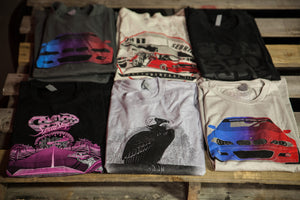
Our latest T-shirt design pays tribute to Hans Kalaschek, who raced a boldly liveried E30 M3 in 1989. He was a grassroots privateer who lacked major sponsors. His car was “freeform” in its appearance, a sort of art-car or “Kunstwerk” in racing form. This car, which has recently been restored to its original glory, presents one of the more unique liveries we have ever seen on a racing car, and thankfully, it is now available for the public to see on track once again as it makes its rounds through historic racing series in Europe.

Our Re-Spec line of apparel thrives on this exact spirit. The Idea of taking something proven and rebuilding, restoring, or reimagining it for a new era. These legendary cars deserve to be experienced by generations to come, and thanks to people like its current owner, Phillipp Kenny, we are happy to say that is possible.
 These limited edition Tees will be available while supplies last. Click the links above to purchase, and as always, stay tuned to our resources section for more historic BMW content.
Leave a comment